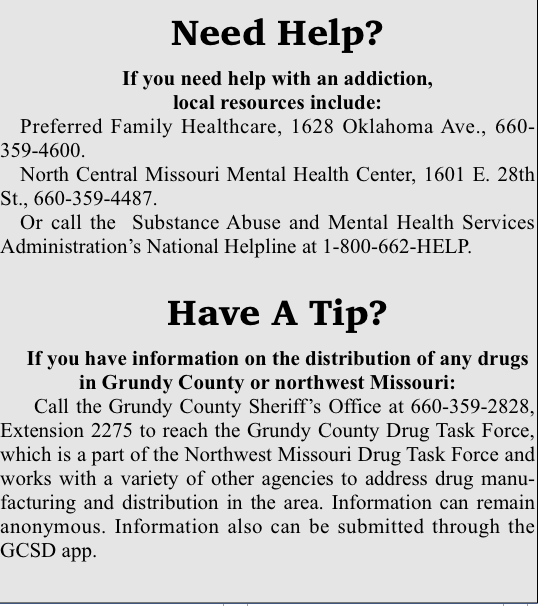
When two Trenton residents were indicted by a federal grand jury last week for their roles in a conspiracy to distribute fentanyl in Grundy County, it might have seemed like just another drug bust. But the lethal nature of the synthetic opioid and its wide availability in northwest Missouri is causing increasing alarm among area law enforcement agencies.

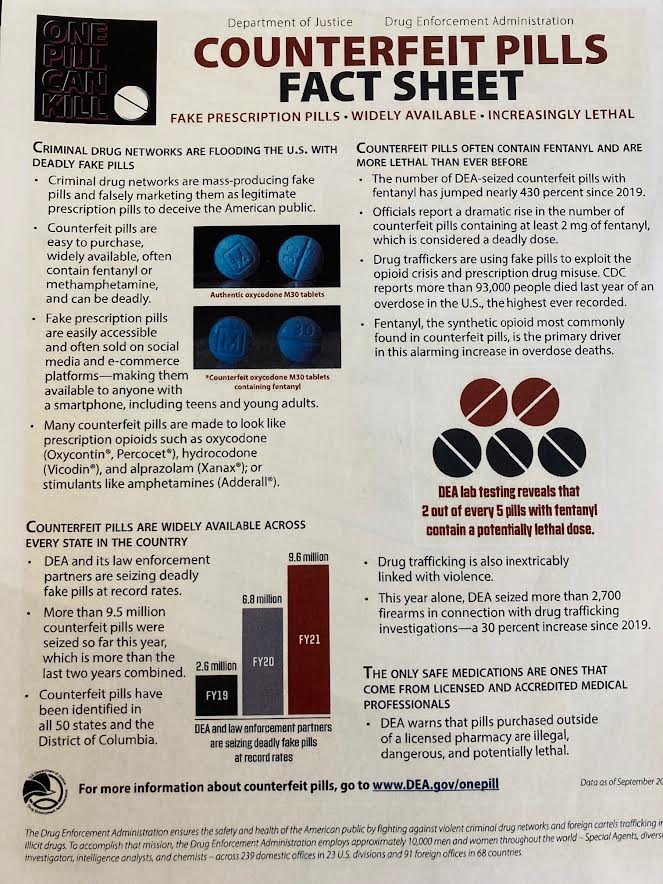
The M30 pills that are being distributed in Grundy County and across the country are sometimes laced with deadly fentanyl.
This website brought to you in part by the following sponsor:

The U.S. Attorney’s Office for the Western District of Missouri last week announced the March 1 grand jury indictment of 24-year-old Troy Lee Palmer and 26-year-old Dallas W. Hughs. The federal indictment alleges that the two men participated in a conspiracy to distribute 400 grams or more of fentanyl since Oct. 27, 2020. Hughs is also charged with three counts of distributing fentanyl in Grundy County on separate occasions between Aug. 23 and Sept. 13, 2021.
In addition to the conspiracy charge, Palmer is also charged with one count of possessing fentanyl to distribute in Grundy County on Dec. 8, 2020 and one count of possessing several firearms in the furtherance of dug-trafficking crimes.
Eric McAllister, officer in charge for the Grundy County Drug Task Force, said it came to light in Oct. 2020 that fentanyl-laced M30 pills were being distributed in Grundy County.
“Before October 2020 we hadn’t seen these blue M30 pills in Grundy County. We went out to make a buy and came across these,” he explained.
In addition to “M30s,” the pills are sometimes known as “percs” and “Oxys.” The counterfeit prescription pills are manufactured in clandestine labs in Mexico with no oversight or regulation and consistently contain a range of substances, the most dangerous of which is fentanyl. The synthetic opioid is 80 to 100 times stronger than morphine and pills laced with the substance are known to be responsible for thousands of overdoses across the U.S., many of which have led to death.
One of the main problems with the fentanyl-laced pills is that there is no way to know which ones are lethal.
“The problem is there might be a small percentage of fentanyl in one of the pills in a bag and a lethal dose of it in another one,” McAllister said.
It’s also relatively easy to get the M30s, which have a huge profit margin for the Mexican cartels that manufacture and distribute them. McAllister and Grundy County Sheriff Rodney Herring said that as the pills come across the Mexican border they cost $1 to $2 per pill. In the Kansas City area, the pills are $10 to $15 to maybe $20 per pill. The pills move into Grundy County through Kansas City and St. Joseph and by the time they get here, the cost has risen to $25 to $35 per pill.
It might seem that the cost would keep the amount of these pills to a minimum in an area such as Grundy County, but Sheriff Herring said his office, which was the lead on the Palmer-Hughs investigation, has seen a large influx of the pills since October 2020.
“We’ve seized thousands of these pills in Grundy County since then,” commented Sheriff Herring, with McAllister agreeing and saying there has been an “onslaught” of the pills.
Across the U.S., 9.6 million of the fake pills were seized in FY21, up from 6.8 million in FY20 and 2.6 million in FY19. There has also been a dramatic rise in the number of counterfeit pills that contain at least 2 mg of fentanyl, the amount that is considered a deadly dose.
If the pills are so dangerous – DEA lab testing reveals that two out of every five pills with fentanyl contains a potentially lethal dose – what makes it worth the risk to continue taking them? McAllister said it’s like any other drug – the need for it outweighs the risk. When someone has been addicted to opioids, McAllister said, they get sick when they don’t have them, so taking the M30s alleviates the pain and sickness of withdrawal.
“The problem is, you never know with these M30s what you’re going to get. So, we’re seeing frequent overdoses,” he said, noting that overdoses don’t always lead to death. “The truth is it’s a cycle that never ends. We don’t see people get off these pills unless they’re in custody. We see people go to rehab, get clean, get out and relapse.”
Someone addicted to the pills, McAllister said, is spending all their time looking for them. The behavior often escalates to heating up the pills and using needles, spoons, etc. to get the drug into their system.
The drug trafficking also has the by-product of violence, with the DEA saying this year alone it has seized more than 2,700 firearms in connection with drug trafficking investigations – a 30 percent increase since 2019. In fact, Palmer’s firearms charge alleges that he possessed a Cricket .22-caliber bolt-action rifle, a Ross .22-caliber rifle, a Ross .410-gauge shotgun, a Ruger .410-gauge shotgun, a Hiawatha 12-gauge shotgun and a Ruger .223-caliber rifle on Dec. 8, 2020.
Putting the dealers away seems like an easy way to solve the problem, but McAllister said there’s a revolving door of those willing to take the chance of getting caught compared to the money that can be made.
“As soon as we get someone off the street, there’s someone there ready to take over,” he explained.
And that’s part of the message McAllister wants out there – that the investigation into the counterfeit pills in Grundy County and northwest Missouri is not over. In fact, he said, those who are distributing the illegal pills should be put on notice that there’s no happy ending for the seller or the user.
“If you’re selling or using fentanyl pills, this is what’s going to happen,” he said. “You’re either going to prison or you’re going to die.”