
While the conversation included comments such as “everyone’s going to die,” questions concerning the reliability of COVID-19 testing and even a reference to the Nuremberg Code, the main concerns voiced at a public meeting hosted by the Grundy County Health Department were in regard to the quarantining of healthy children and the effect the isolation imposed by the quarantines is having on those children.
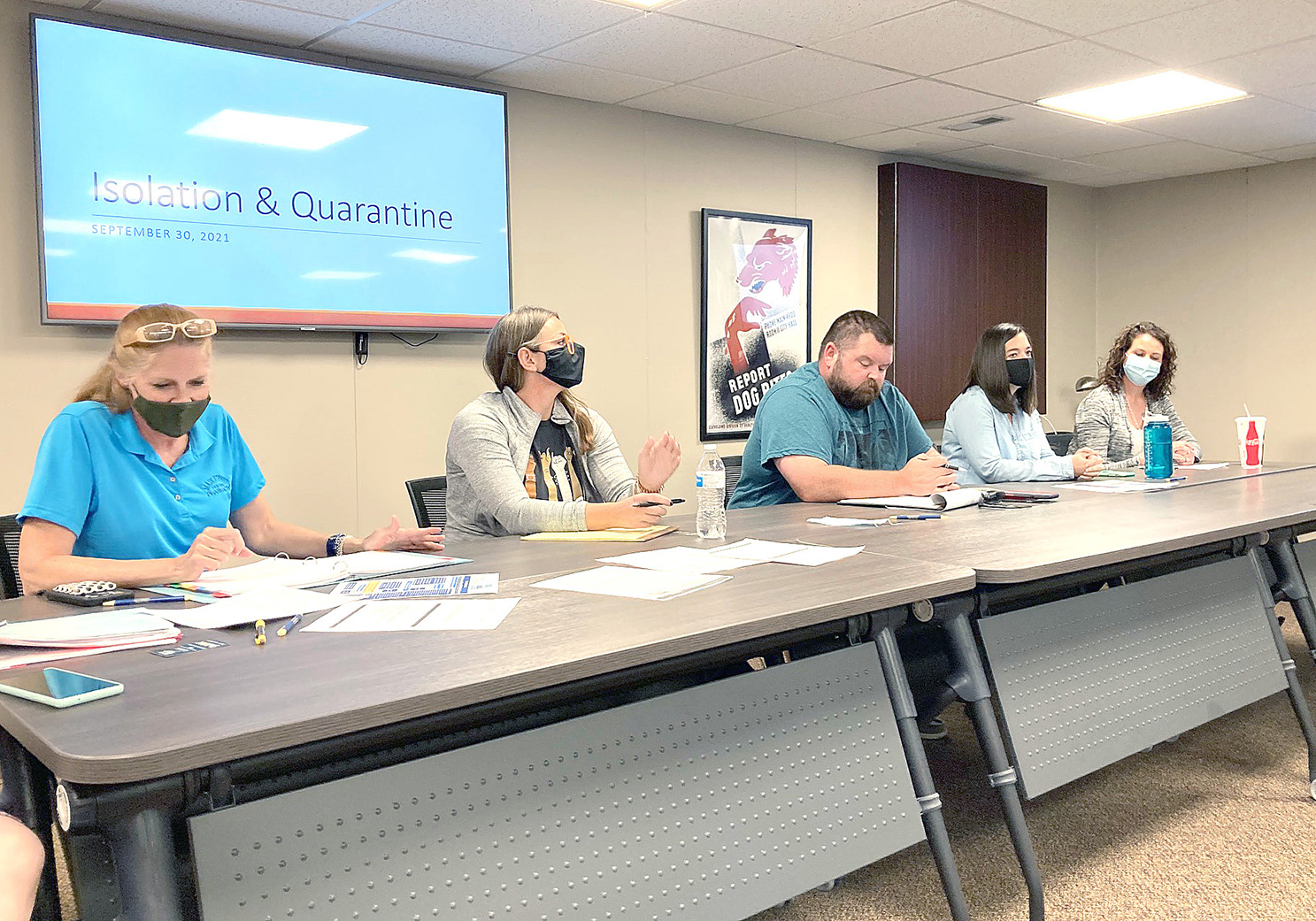
R-T Photo/Ronda Lickteig
The board of directors of the Grundy County Health Department held a meeting Thursday evening in an attempt to get input from the community concering isolation and quarantine guidelines in relation to COVID-19. Pictured are, from left, Board President Dr. NiCole Neal, Cari Blackburn, Phillip Ray, Taylor Ormsby and Korynn Skipper.
This website brought to you in part by the following sponsor:

The meeting, in which the majority of attendees (including a member of the GCHD board) declined to wear masks as requested, was held at the health department Thursday evening. Board President Dr. NiCole Neal said the forum was meant to gather information from the public – to get a “baseline” of opinions and ideas concerning isolation and quarantine measures. She told the group, which numbered around 50, that the GCHD staff has basically worked around the clock since the pandemic began and is trying to educate and take care of the community.
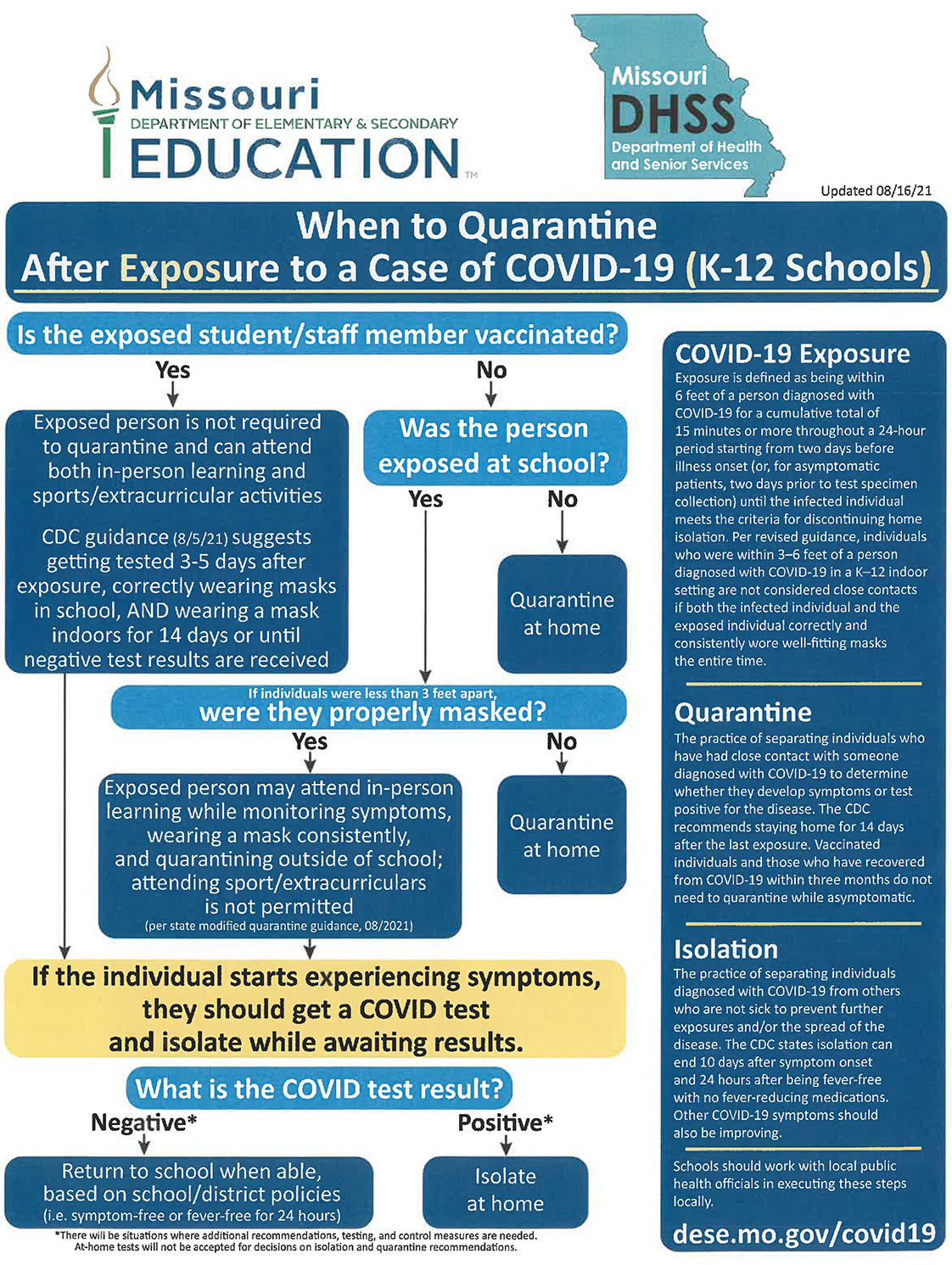
The Grundy County Health Department handed out an outline for how decisions are made to determine isolation and quarantine.
GCHD Administrator Elizabeth Gibson said this is the first time the health department has really had to interact with the community in this way and the health department has the authority and the mandate to take the actions it has taken in an effort to educate and protect the public. State statute demands that the guidelines set by the local health department be “at least as stringent as the guidance by the Department of Health and Senior Services,” she explained.
Ms. Gibson outlined how the health department and the school districts work together to identify who is a close contact to a positive COVID case and noted that guidelines have changed as the pandemic has moved into its second year, actually the third school year. For instance, the quarantine period was previously 14 days, but has been shortened to 10 as research has shown that a person is much less likely to transmit COVID after 10 days. She reiterated the importance of masking and the role it plays in cutting down on transmission.
Following that introduction, the floor was opened to the public, with each person allowed three minutes to speak.
Tammy Burgess said she doesn’t understand the guidelines and said that many school districts are not quarantining in the way Trenton R-9 currently is. She said the district is discriminating against students who are eligible for the vaccine but choose not to be vaccinated. She advocated suing the school district, which she said is who should be taking responsibility for how they quarantine. Special treatment for vaccinated students should stop, she commented.
Pam Bowden, a third grade teacher at Rissler Elementary School, said she had COVID-19 in November. She noted that none of her family or her students contracted the virus from her. She told the board that her children have been quarantined and one of them in particular did not do well with the Alternative Method of Instruction (AMI) that was offered. She presented a proposal to the board, which she said has been implemented in other districts, that if a student is identified as a close contact to a positive case, the parent could choose to quarantine the student or the student could continue to attend classes, but would be required to wear a mask.
“Since masks work, it should work,” she said.
Mrs. Bowden told the group that 50 percent of third graders at Rissler now qualify for Title I Reading services, something she said has occurred because of the amount of time they have spent out of the classroom. Ms. Gibson replied that if a student was initially wearing a mask when the contact occurred, they would not have to quarantine at all.
Pleasant View R-6 Superintendent Rebecca Steinhoff discussed the situation at her school, students struggle when told they have to go home and during their quarantine time when they have no social interaction. Mrs. Steinhoff shared several statistics and observations concerning the school in the 2020-21 school year, which she provided to the Republican-Times over the weekend. They include:
• preschool through eighth grade students were quarantined 934 school days or 6,538 instructional hours from Aug. 2020 to Feb. 2021; of those, 47 students in grades kindergarten through eighth were quarantined for a total of 601 school days and 48 preschool students were quarantined for a total of 333 school days.
• of the 95 students that were quarantined by the health department, only eight tested positive or were probable cases. Of those eight, seven were already quarantined due to a family member testing positive at home and one case had an unknown origin.
• multiple classrooms had to be sent home in the middle of the school day. The students had already been exposed to each other and around each other most of the day. (She questioned whether a couple of hours really made a difference).
• students lacked social interaction for 10 to 24 days in some cases and she noted that district personnel has seen the repercussions of the isolation.
• probable cases have been incorrect. Last Christmas, 20 preschool students and two staff members were quarantined on Christmas by mistake.
She told the board that R-6, which on the first day of class this year had an enrollment of 121 plus 20 preschoolers, can quarantine in the classroom if needed. Asymptomatic students, she said, can eat in their classroom, go to the playground at a time when other students are not on it, use a separate bathroom from other students, etc. When asked later if students at R-6 have ever worn masks, she declined to answer. She also told the group that statistics that involved the Trenton R-9 School District would include R-6 students as well.
Ann Constant told the group that her grandson, who lives out of the area, was quarantined with no symptoms, however he did test positive, meaning he could have been transmitting the virus even though he wasn’t sick. That, she said, is the point of quarantining – stopping someone from inadvertently transmitting the virus when they don’t even know they are sick.
Richard Etter called the situation “tyranny” and said it is taking away his rights under the U.S. Constitution.
“The Constitution doesn’t say we give up our rights because people are dying,” he said before asking why this illness in particular has led to such drastic measures that are “trampling” on his rights.
“We’ve been dying since the beginning of time,” he said.
Charlotte Hamilton discussed statistics she found online that indicate 150 Trenton R-9 students have had COVID. She was interrupted by Etter, who said, “It doesn’t matter. It’s our God-given right to freedom.”
Mrs. Hamilton went on to say that just because a student tests positive doesn’t mean they are sick and described the effect the loss of class time and social interaction had on her kindergarten-age grandchild.
Jeff Spencer, who had asked a board member who requested he wear a mask what they were going to do if he didn’t, told the board that his children have been quarantined a total of 11 times – without ever being sick or even having symptoms. He said he and his wife are a “rare breed” in that they are able to sit down with their kids and work with them during their quarantined time. He said that in his job as a Trenton police officer, he sees many kids who need school because that’s where they get food, love, etc.
“They have no home life,” he said. “Healthy kids are being sent home to a much worse home life. They are safer at school than at home.”
Toby Havens agreed with Spencer and said he is concerned about the students who are missing school. He said people need to be able to separate fact from fiction and questioned the reliability of home tests. He told the group that he sees the virus “as no different from the flu” and that the actions being taken take away his constitutional rights.
Dennis McDonald asked a technical question of the board.
“How many cycles does it take to replicate the DNA to make it (the test) positive?” he asked, telling the board that he has heard that if you “run it up to 44” everyone is positive. However, he said, if it is kept “around 30” the results are more reliable. Dr. Neal said she will look into it and that she, as a pharmacist, sends tests to a lab.
Venissa Burchett spoke about the effect quarantine has had on her children, particularly her daughter, who was sent home. The child, she said, was upset because she knew she wasn’t sick. She said that when she attempted to use the GoogleMeets program for her classwork, it gave wrong results for her work, which was again upsetting to the student. None of the students who were quarantined developed symptoms, she said, and the students, ages nine and 10, knew they needed to be in school and were even more upset when they learned that the child who was sick and had made the quarantine necessary was back in school before they were. Another issue, she said, was that she had to take a week off work, without pay, something not everyone can do.
Ben Thomas told the board members that the policy they’re supporting – giving special treatment for those who are vaccinated – is wrong. He said “left-minded” coaches are telling athletes that if they are vaccinated they won’t have to miss games. He mentioned the Nuremberg Code, referring to ethical principles that should be followed for research on humans, and said it’s kids who are being affected. He said it would be a “major problem” if anyone tries to make him get his children vaccinated.
“The government screws up everything they touch,” he said, noting that he’s not convinced it’s safe and saying that he’s from Missouri so you’ll have to “show” him. He went on to say that the board needs to end the policy of special privilege for those who have taken the vaccine.
“So you’d be okay if the policies match?” asked Dr. Neal, meaning that if vaccinated and non-vaccinated students were treated the same when it comes to quarantine.
“If the policies matched that would be a step in the right direction, but I’d like to see all the mandates go,” Thomas replied, saying that it’s a “huge infringement” on his rights.
Kadi Gamble said she doesn’t feel like kids have equal opportunity right now. Her son, who was quarantined twice last year and never got sick, didn’t do as well academically when quarantined.
“He did not have the same opportunity as the kids sitting in the class,” she said.
Brandon Gibler, who later said he was not speaking as a member of the Trenton R-9 board but as an individual, said we know the transmission in school is less than at other places, regardless of whether the student is masked or not.
Ron Ratliff, who identified himself as the pastor of Tenth Street Baptist Church, said he appreciated the work the health department staff has done and admitted that while COVID is a serious issue, the bigger issue is that if it doesn’t get settled he is scared there will be backlash.
“It’s going to get ugly,” he said. “There needs to be some compromising.”
Nathan Rorebeck asked about natural immunity and the role it plays in determining who will be quarantined. Some kids, he said, have been quarantined over and over and have never been sick. He said the board needs to take into consideration kids who have already had it and how many times they’ve been quarantined. Saying that, for kids, it’s “not life and death” unless perhaps the child has really bad asthma. The isolation and loss of learning can have a devastating effect, he said.
“It changes their life – changes their outlook,” he said. “It could change the trajectory of their life. Definitely quarantine the kid who has it – look at kids close to them – but they should be okay if they’re vaccinated or have natural immunity.”
Norman Ropp said kids learn by facial recognition and said when masks are worn kids can’t recognize anyone. He discussed the effect quarantine has on students who then feel isolated and upset, especially when they are sent home.
“We’re bullying them with the rules and regulations of the CDC,” he said, asking that the board consider the home life of some children. He asked if the board would take a vote that night to make changes. Dr. Neal said the board would be meeting to discuss the input they had received but did not plan to take any votes that evening. She told him and the group gathered that all of the health department board meetings are open.
Gina Rorebeck also told the board she appreciates the work the health department staff has done during the pandemic, but wanted to reiterate what Spencer had said about the effect quarantine is having on students. She asked that research on the efficacy of keeping the students home be looked at and told the board that the group gathered is just a small number of the people who feel as she does. She asked that the R-9 board do a survey to find out how many parents feel the same way.
Rosetta Marsh shared her daughter’s experience of having to miss all of the Trenton High School Homecoming activities due to quarantine and said she was told that she could do a home test. Based on when her quarantine was put in place, if her test had been positive, she would have already exposed people she had been around at school.
Phillip Ray, who is a member of the board and the presiding commissioner of the Grundy County Commission, asked who is responsible for contact tracing – the health department or the school? Ms. Gibson told him that when the health department is notified of a positive case, the school identifies who is a close contact, however, the health department does have access to class lists, attendance records, etc. The health department then notifies the district on the days to count, based on when the person showed symptoms. Sometimes it takes a while to get results, she said.
“So basically, the school does the contact tracing,” she said going on to say the health department has a good relationship with the school and the process allows them to identify the minimum number of students who should quarantine.
When asked if school districts are required to assist with contact tracing, Ms. Gibson replied that as far as she knows, yes, they are but she would need to check with the Department of Elementary and Secondary Education.
Ray said that CARES Act Funding, distributed through the county commission, allowed for each district to have a school nurse, however, it was noted that only the Trenton R-9 District has full-time nurses. He said the county felt that “if we’re going to require it, we should fund it.”
Mrs. Marsh said she knows there are parents who are saying their child is positive because they can return to school sooner than a child who is quarantined but does not test positive. Those students who came in contact with them then have to quarantine. Gibler agreed that is happening and said that those students are then inadvertently making other students have to quarantine.
Ray asked if there is any precedence for asymptomatic people to have to quarantine. He was told that tuberculosis and pertussis (whooping cough) are two examples of such illnesses that require quarantine.
Ms. Gibson told the group that the DHSS requires that “any person who is infectious shall not attend school” and the health department has certain authority.
“We do not have authority over the school. We do have the authority to close establishments,” she explained. “We don’t issue guidelines. DESE and DHSS might be, but we’re not requiring anything from the school district.”
Ray went on to say that he would like to see the boards (health department and the county’s school boards) come together to find a way to keep kids in school. He said the situation is “ever-changing” and “we can’t assume the polices we start with are the policies we stay with.”
Korynn Skipper, a member of the board, said that would be a starting place and that Grundy County is completely different from large metropolitan areas such as Kansas City or New York.
Gibler expressed his opinion that the school is the “least transmissible place we have in our county, statistically speaking.”
Ray asked if the health department has local control, noting that Missouri Attorney General Eric Schmitt has taken steps to go against what some local entities have chosen to do. Gibler said the local health department does have local control.
Dr. Neal responded that the health department must make their policies strong and asked that moving forward, the group “stand by” them and “back” them.
“Get rid of the quarantine and we’ll back you,” Gibler replied.
Ms. Gibson, asked about the liability of the health department in light of “hold harmless” legislation concerning COVID, replied that it depends.
“There’s no liability as long as we’re doing what we’re supposed to be doing,” she said. “If we’re not being negligent.”
Amy May said that her son does not do well in quarantine but her main concern is that if he is exposed and brings it home, it could make her or his elderly grandmothers sick. She said the health department staff is doing their job and said people need to follow the guidelines. Many children, she said, are now living with grandparents or great-grandparents and could be exposing them. Noting that she works in the mental health field, she said she has seen first-hand the effect the COVID situation is having on people – and not just because of quarantine and isolation.
“It hurts people’s mental health to have their loved ones die,” she said, with someone in the crowd interrupting with “everyone’s going to die.”
Mrs. Rorebeck said that while she doesn’t discredit what Mrs. May is asserting, children are being hurt by not being in school. She said if masks and vaccinations are truly effective, why is there fear from people who are vaccinated and wear masks?
Ray ended his comments by saying he believes the board should let entities “do their thing” and the health department will “do our thing.”
“Let schools do what’s best for their students in their buildings,” he said. “I don’t feel comfortable dictating to a board that I don’t sit on.”
The evening ended with Dr. Neal telling the group that the health department board will look at the comments and opinions expressed at the meeting and will plan another meeting in the next couple of weeks. Information about that meeting will be announced when it becomes available.