
When Steve Schieber looks back on his career in hospital administration it’s likely that 2021 will stand out in his memory for the challenges that came from COVID-19. But there are many reasons for the Wright Memorial Hospital CEO to look back on the past year and remember the successes the hospital was a part of during a time of change, adaptation and innovation.
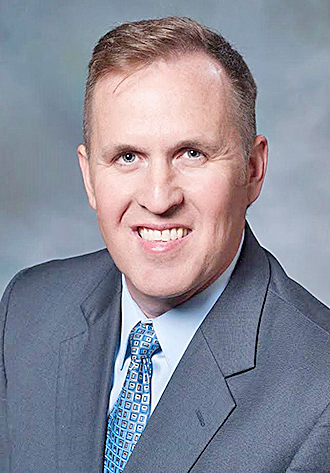
Wright Memorial Hospital CEO Steve Schieber
This website brought to you in part by the following sponsor:

Find out how to advertise here –
Email us! [email protected]
Schieber oversees the critical access region that includes Wright Memorial Hospital in Trenton, Hedrick Medical Center in Chillicothe and two Kansas facilities, Anderson County Hospital in Garnett and Allen County Hospital in Iola. He points to a few major recognitions this year as proof that Wright Memorial is providing the quality the community expects: the five-star rating by the Centers for Medicare and Medicaid Services; the Gold Seal of Approval Accreditation by The Joint Commission; and the Mission:Lifeline EMS Bronze Achievement Award from the American Heart Association.
Evaluation for The Gold Seal, which occurred through an unannounced visit in October 2021, was something the hospital leadership and staff had prepared for by doing what they strive to do every day – provide exceptional care.
“We had a window of when they would come, but we knew that window can be broken so we were always ready for it. We had actually expected it months earlier but it was postponed due to COVID,” he explained. “So we were always ready. We were in non-stop constant preparation for it. But we had great leadership and great staff so we were already meeting that criteria, that quality of care. To do that in the middle of COVID was, to me, staggering.”
The hospital also earned the Bronze Achievement Award from the AHA, an honor that points to the processes in place to ensure that a heart attack patient who is taken to WMH has the very best chance of survival and recovery.
“We got bronze because of the level of care we provide – we aren’t doing transplants or heart surgery,” commented Schieber. “We have our processes in place to work with EMS and to partner with Saint Luke’s to do our utmost with our heart attack patients to give them every chance of survival.”
The five-star rating by the CMS is a prestigious award, especially since Wright Memorial Hospital is the only critical access hospital in the state of Missouri to earn it. Critical access hospitals, designated by CMS, are ones that received the special designation by the federal government as part of the Balanced Budget Act of 1997 to allow cost-based reimbursements. It was put in place to allow rural hospitals such as WMH to maintain financial stability and hopefully, Schieber said, sustainability. The designation requires the hospital to have a 25-bed limit with an average length of stay of 96 hours or less.
WMH had other successes in 2021 as well with the hiring of a new physician recruiter to oversee recruitment among the four hospitals over which Schieber is involved. Recruiting physicians to rural areas such as north Missouri is a challenge unto itself and it’s really where everything begins.
“We have a great staff but it all starts with the doctors,” Schieber explained. “There’s not enough of them to go around to the rural areas and although we are blessed to have so many, they’re not going to be in their jobs forever. We need to have our physicians in place for when that happens.”
Schieber said the recruiter is already meeting with medical students and residents to do rotations at Wright Memorial and hopes those connections will help bring more physicians to the area.
“We have the best success with those who have local ties. It’s all about relationships,” he said, noting that Dr. Jessica Snyder, who grew up in Newtown, recently joined the Saint Luke’s family.
There are many reasons for local residents to be confident in the care they receive at WMH and one of them is the hospitalist program that’s in place. The hospitalists are able to focus solely on the hospital patient rather than have outpatient or clinic hours.
“The hospitalist program is really unique and it’s been a big key to our success,” Schieber said.
Of course 2021 brought challenges and most of that was COVID-related in one way or another whether it be trying to keep staff members healthy, making decisions about vaccines or filling the swing-bed unit when procedures that usually fill those beds were cancelled. Schieber said the hospital made the decision that all staff would be vaccinated before many other health care facilities made that call.
“You can see that we were ahead of the game by requiring vaccinations now that CMS has mandated that all employees have it,” he said. “And it was the right call because it has proven to greatly lessen the number of employees who are out due to COVID. It has definitely made a difference.”
Schieber said there are employees who have received religious or medical exemptions and they are tested regularly. He admitted that there were staff members who made the decision to leave rather than be vaccinated against the virus.
“We lost around 5 percent of our employees due to the mandate,” he said. “But we’ve been able to weather the challenges across the spectrum and work through that.”
The pandemic, he said, created a lot of “wear and tear” on the staff. Many worked double shifts and managers were working other jobs within the hospital to meet the needs. As the COVID-19 numbers grew, Schieber said, it had an effect on every area of the hospital.
“I think the public may not realize that their actions can have an impact on our staff,” he said.
Saint Luke’s came up with a plan to handle the large number of patients, with one central triage location determining which patients needed to be admitted and to what level of care. He explained that there were days when patients had to be put in beds in the emergency department because there were not hospital beds in the metro areas available for them. Programs such as telemedicine were utilized to be sure the patient was getting a high level of care until they could be transfered. Because procedures like hip replacements, which often result in local patients using the swing-bed unit at WMH, were not being performed, there were beds available when needed.
“We’re just now starting to see some of that coming back,” he said of the swing-bed patients.
WMH, Schieber said, is on solid ground and its economic impact in the community – with a payroll of about $15.5 million for 185 full-time employees – is great.
“They say that for every dollar it turns over six times in the community. If that’s true, then Wright Memorial has a $90 million a year impact. We typically pay the highest wages in both communities (Trenton and Chillicothe) so it has a dramatic impact on the economy.”
Looking ahead to 2022, Schieber is optimistic. The volunteer program, under the direction of Dave Bain, is back up and running and is vital to the mission of the hospital. The specialty clinics are being expanded and hopefully, COVID-19 is going to become less of a factor. While no one wanted a pandemic, it has resulted in something positive: innovation.
“We’re all happy that maybe we’re moving past COVID. We’re excited that while COVID has been a challenge, it has caused us to really be innovative,” he said. “That is only going to add to our ability to serve our