Couple’s Child Was Born With Type 1 Spinal Muscle Atrophy
Editor’s Note: This is the first part of a two-part story focusing on the Weaver family’s journey following the diagnosis of their infant son, Payne, with Spinal Muscle Atrophy.
 As we say goodbye to 2020, many people are also saying “good riddance!” There’s no doubt it’s been a year unlike any other in modern history, but for Jim and Hannah Weaver, 2020 will always be remembered as a year that brought a life-changing blessing and revealed their strength as a family in the face of a tremendous challenge.
For the young couple, news of a pregnancy in 2019 was unexpected as Hannah had been told that the likelihood of her getting pregnant was very low. With shared custody of Jim’s son, Drake, then 9, the three were a family – complete even if no other children were ever to join them. But with a new little one on the way, the couple looked forward to becoming a family of four. Hannah experienced a routine pregnancy, with no complications and with a husband who found her even more beautiful as she carried their son.
“Overall, she was the prettiest little pregnant picture you could imagine,” he recently wrote of her during that time.
On May 11, as the world dealt with the early days of the COVID-19 pandemic, Jim was laying on the “dad couch” in Hannah’s room at Liberty Hospital, reading – perhaps prophetically – Ryan Holliday’s book, “The Obstacle is the Way: The Timeless Art of Turning Trials into Triumph.” Just before noon, the nurse checked Hannah and they knew it was “go time.” Payne William Weaver (his first name is from Jim’s childhood hero, the late golfer Payne Stewart; William was selected by Drake) entered the world at 7 pounds, 14 ounces. All was right in their world.
Fast forward to May 16. Jim was working on the couple’s farm about 15 minutes from their home in Trenton when he received a phone call from Hannah telling him she’d been notified that there was “something wrong” with Payne. Believing that maybe she was just being a stressed new mom, and knowing that Payne acted like a perfect newborn, he headed home to console her. But he also did what many of us do first when we’re looking for information: he Googled “SMA newborn,” the condition Hannah had been told Payne’s newborn screening had shown. He clicked on a link to “SMA Statistics” and felt what he describes as a punch in the gut like he had never felt. What he took away from that initial “research” was that the life expectancy for a Type 1 SMA baby was 18 months to two years. He had never even heard of SMA, Spinal Muscle Atrophy.
As he sped back to town, he called his parents, Kenny and Vicki Weaver, and had them meet him at home. The scene he describes and what happened in those first moments is, on one hand, heartbreaking, and on the other hand, a glimpse into how this family was going to handle a crisis.
“I walk in the front door to a sleeping baby, my wife sobbing, my mom sobbing, my dad looks sick and my 10-year-old, Drake, is bawling. He and I have been through thick and thin together. I hug Hannah, grab Drake and go outside. I tell him we don’t know anything but this is going to change everything. It’s going to be hard and that we’ll do it together. He and I have always been like that together. He doesn’t understand what’s happening; he just knows this is bad. I’ve had rough days in my life, but that one takes the cake. May 16 stands alone in our lives.”
But as that day stands alone as the worst, Sunday, May 17, will be remembered by this family as well. That’s the day the couple woke up to a beautiful day. They looked at each other and determined that they would never have another day like May 16. Whatever was going to happen, would happen but they would be positive and seek solutions. They would not feel sorry for themselves or for Payne. And from that point on, that’s exactly what has happened.
The next day, Monday, May 18, the family received a call from their Children’s Mercy Hospital caseworker, Anna, who began preparing them for what was to come with a diagnosis of Type 1 SMA. The rare genetic neuromuscular disease (only 1 in about every 10,000 children are born with it) affects the part of the nervous system that controls voluntary muscle movement. The disease causes the loss of important cells in the spinal cord called motor neurons, which are essential for muscle strength and movement. The neurons help regulate muscle activity by sending signals from the central nervous system. The loss of functioning motor neurons leads to progressive muscle weakness and atrophy as muscles stop receiving signals from the central nervous system.
In Payne’s case, both of his parents are carriers of the gene, so he inherited one mutated SMN1 gene from each parent. As this was explained to Hannah, she questioned if perhaps the actual diagnosis was incorrect because Payne would have had only a 25 percent chance of having SMA. He would also have had a 25 percent chance of not having SMA and not being a carrier and a 50 percent chance of being a carrier, but not having SMA. So, maybe, she thought, he was actually just a carrier?
R-T Photo/Ronda Lickteig
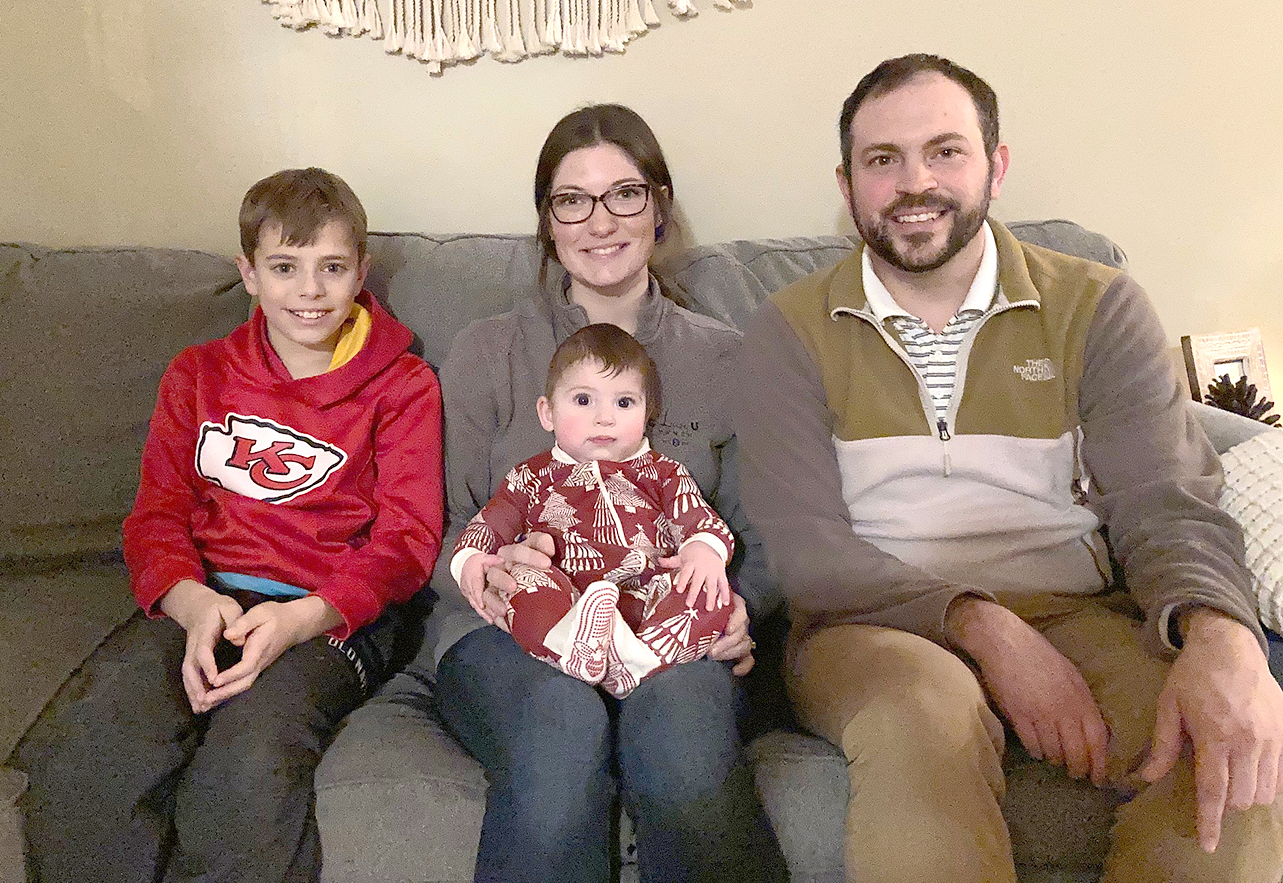
Payne Weaver, center, was born with Type 1 Spinal Muscle Atrophy, something only 1 in about every 10,000 children are born with.
This website brought to you in part by the following sponsor: