
by Ronda Lickteig
R-T News Writer
You can find 100 television shows that will tell you that with a little bit of shiplap and the right budget you can turn any house into your dream home.

R-T Photo/Ronda Lickteig
Using a lot of imagination and even more hard work, Mike and Nancy George converted their working barn into a beautiful, unique residence.
This website brought to you in part by the following sponsor:

But how many of them show you how to turn your barn into the house of your dreams? Well, not many, which is how rural Trenton residents Mike and Nancy George found themselves with chalk and a measuring tape on the floor of their barn as they began transforming it into a unique and beautiful home.
The barn, located on their family farm northwest of Trenton, was still in use when the Georges decided they would turn the structure into a house. The couple had other options when they decided it was time to move from the ranch-style home they constructed in 1992.
“The decision to move out of our house came first,” Nancy said, noting that as empty-nesters they had found themselves living in four or five rooms of their 2,400 square-foot home. The couple had raised their daughters, Michelle and Annie, on the farm and now Michelle and her husband, Aaron Stark, were selling their house in Trenton and looking to move to the country with their own children. The decision was made that the Starks would move into the George family home, which was actually the second house Mike and Nancy had lived in on the farm. That left Mike and Nancy with a decision: where to build. One idea was to just build a new house on the farm.
“Originally we thought about building on the other side of the bins, where we couldn’t see their house and they couldn’t see ours,” Nancy explained. “We thought about building on Lester’s (Mike’s father) farm, but this has always been Mike’s farm, so we kind of wanted to do it on this farm.”

R-T Photo/Ronda Lickteig
This stairway is a focal point of Mike and Nancy George’s converted barn. Getting the angles right on the trusses and making sure everything was square was a huge challenge during the conversion.
Nancy had entertained the idea of converting the barn into a home, but Mike wasn’t interested. With a plan still not in place, Mike and Nancy moved into his parents’ basement in November 2016 and the Starks moved into the farmhouse the next month. Over the winter, Mike and Nancy went to Texas with her parents and on the way home in February they saw a house that was a converted barn. According to Nancy, Mike apparently had some sort of epiphany when he saw it.
“Something just came over him and he said, ‘We can do that!’.”
R-T Photo/Ronda Lickteig
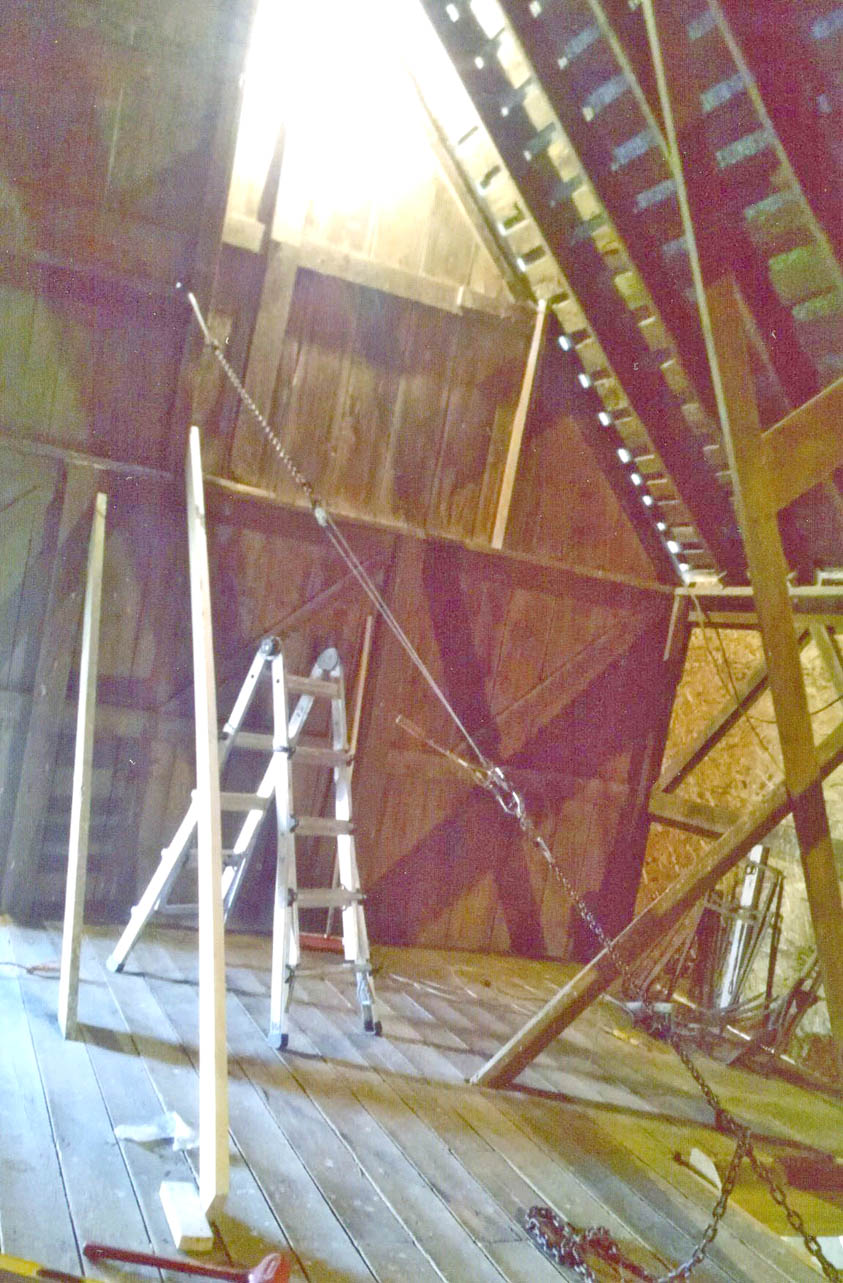
The George’s barn, which has been on the property since at least the 1930s, was still in use when the couple decided to renovate it.
The first step was to be sure the renovation was feasible – both structurally and financially. The Georges had purchased the farm in 1985 and the previous owner told them it was on the property when he moved there in the 1930s, so they wanted to be sure it was structurally sound.
“I asked (local contractor) John Eller to come look at it and he said it was structurally safe, but he didn’t think money-wise it was feasible,” Mike laughed.
A second opinion from Noah, an Amish friend, confirmed that the building was structurally sound and the decision was made to move forward.
The couple knew they wanted a two-bedroom, two-bath house with a kitchen and living room. They began designing the floor plan with chalk and a measuring tape, using one color of chalk one day and a different color the next day when they made a revision. The barn still had hay in it when the renovation began; where the kitchen and living room are now located was the granary. The south wall of what is the living room was open to the loafing shed.
The Georges decided to leave the exterior intact, with all new construction on the inside.There is about a foot between the exterior walls and the interior walls, with foam insulation blown into the space. The lower level is the garage, with corrugated metal walls and a staircase (with a stair lift) that leads to the main living area.
R-T Photo/Ronda Lickteig
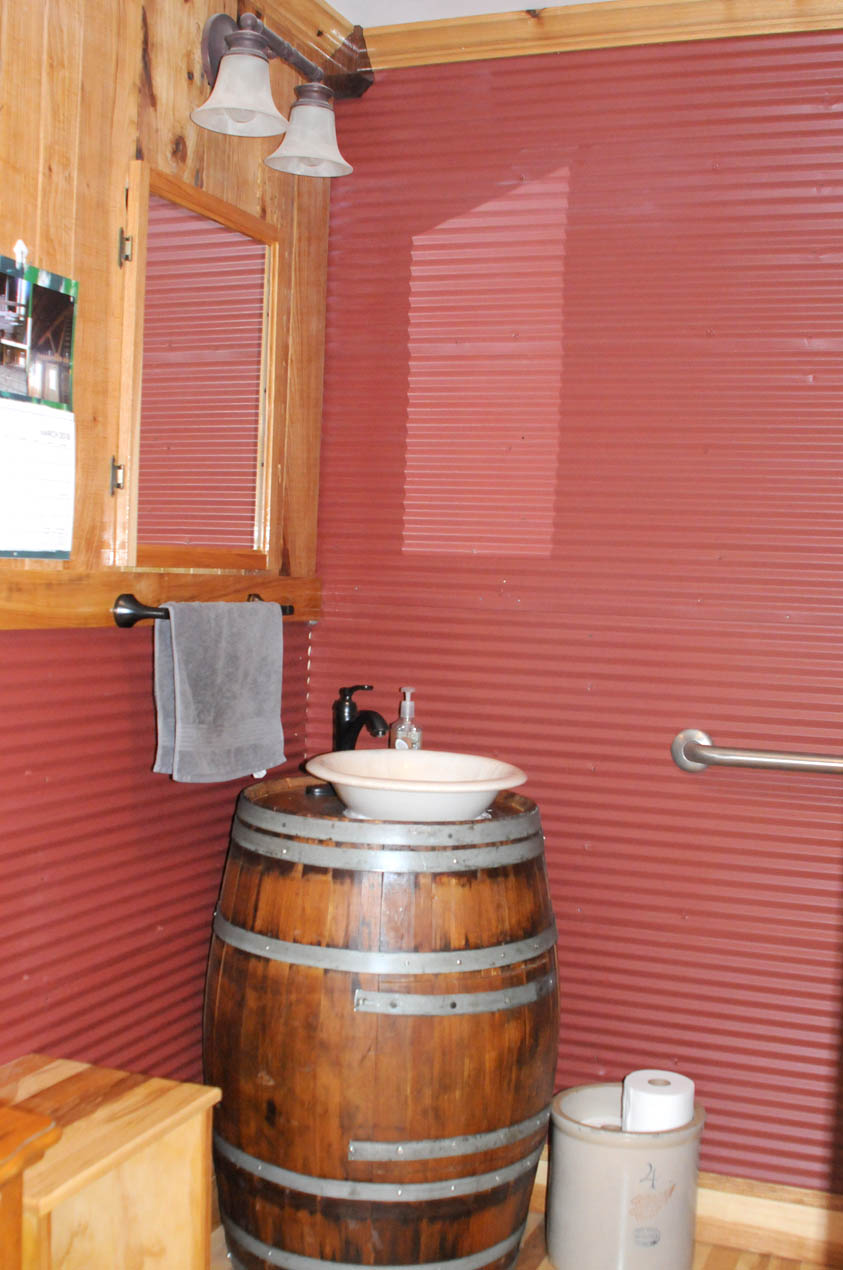
The sink in the guest bathroom of the George home is made of an Argentine beef barrel and a sink bowl purchased at a flea market.
The main floor includes an open kitchen/dining/living room area, as well as the master bedroom and bath, a guest bath and Nancy’s sewing room. Almost everything in the house has been reused, such as the tin on the ceiling, which was the original tin on the barn, just flipped over. Some of the barn doors are original to the structure. As one would expect, wood is the theme, but what you might not expect is where it came from.

R-T Photo/Ronda Lickteig
Granddaughter Hannah Stark designed the floor of the upper level library in the George home using the one-inch remnants from lumber used in the renovation of their barn.
“All of the wood except for the floor was cut off this farm,” Mike explained, noting that the shiplap (of course there’s shiplap!) is hickory from the farm. While they wanted to use the original barn flooring, they couldn’t get it smooth enough for floor use.
For Mike, the hardest part of the renovation was getting things square in an old barn and figuring out the angle of the trusses, something that son-in-law, Aaron, a teacher at Trenton High School, was credited with doing. For Nancy, the hardest part had nothing to do with math and everything to do with time.
“For me, the hardest part was waiting for it to get done!” she said.
Nancy said at times it seemed almost impossible that the barn could ever be their home, but she felt she had an assurance from above that it was going to happen. In her journal entry she had written about verses that tell us to “pray boldly” and that “nothing is impossible with God.” She wrote that while it might seem impossible to her, it was not impossible to God.
“I will trust that,” she wrote.
One of the home’s most striking features is the open staircase leading to the upstairs that overlooks the main floor. The second level includes what they’ve come to call “the library,” an area with a unique floor that is certain to be a topic of conversation for generations of Georges to come. Granddaughter Hannah, a student at THS, designed the floor using the one-inch wood scraps from the 2×4, 2×6 and 2×12 pieces of lumber that were used in the renovation. She laid them on end to create an interesting and beautiful floor design that almost looks like brick cobblestone.
There are little touches everywhere that make this house so unique – the light over the dining table is secured with chain; an old awning is attached to the wall in the entryway; and the sink in the guest bath is a flea market find sitting in an old Argentine beef barrel.
“We got a lot of things at the Habitat for Humanity Re-Stores,” Nancy said. “You can get things dirt cheap there. Almost every thing else we got was from second-hand stores.”

R-T Photo/Ronda Lickteig
The light over the dining table is secured to the ceiling with chains. All of the wood with the exception of the flooring came from wood cut on the farm, including the hickory shiplap.
Soaring ceilings, open concept, shiplap – the home checks off all the items sought out in this home renovation obsessed world, but somehow as you stand in it, you feel like you’re standing in a piece of history. The couple is thrilled to be back at their farm and you can still hear in their voices the awe they feel about the transformation of the building that has been such an integral part of their lives.
“I honestly never envisioned it would look like this,” Nancy said. “That it would be this beautiful.”